Cool-Season Crops to Direct-Sow Before the Last New Mexico Frost
New Mexico gardeners often see a mild afternoon and wonder whether it is safe to sow outdoors, even while frost remains possible. The answer depends on the crop, the soil, and the conditions in your particular yard—not a single statewide date. Here’s how to choose cool-season crops, prepare a bed, and sow with less guesswork before the last spring frost.
Why sowing before the last frost can work
A frost date is a planning aid, not a promise that freezing weather has ended. In New Mexico, elevation, slope, nearby buildings, wind exposure, and cold-air drainage can all affect how a garden fares. A warm, sunny bed may be ready for sowing while a low spot nearby still collects cold air overnight.
Cool-season crops are a useful place to begin because they generally tolerate cooler growing conditions than warm-season crops. That does not mean every cool-season plant can withstand every freeze. Seeds, newly emerged seedlings, and established plants may respond differently to cold, and the amount of protection a crop needs depends on the conditions. Check the seed packet for the crop’s specific guidance, then use your garden’s recent weather and soil condition to decide whether to sow.
Direct seeding can suit crops that do not need to be started indoors and transplanted. New Mexico State University describes direct seeding as sowing crops like carrots and beans straight into the garden soil when conditions are favorable. For a pre-frost planting, the practical question is whether those conditions are favorable in your bed now—not simply whether a calendar date has arrived.
Think about the soil as well as the forecast. A bed that is wet, clumpy, or difficult to work may not make a good seedbed even when daytime temperatures feel pleasant. If the soil is workable and the forecast suggests a suitable stretch of weather, sowing can be reasonable. If cold, unsettled weather is expected, waiting or using a cover can reduce the risk of exposing tender seedlings.
The phrase “before the last frost” can also be misleading if it sounds like a precise appointment. Frost dates describe probabilities, and a final frost can arrive later than expected. The safer approach is to combine a regional calendar with observations from the garden itself. For a wider overview, use New Mexico Frost Timing and Growing Season Guide and compare it with New Mexico Planting Calendar by Elevation and Zone. For the way local slope, shade, and exposure can change timing, see Matching Your Garden Schedule to New Mexico Microclimates.
A bed can be ready before the surrounding landscape
A sheltered garden beside a wall may warm sooner than an exposed plot, while a basin or low corner can remain colder than nearby ground. Dark, bare soil in a sunny bed may also warm faster than shaded or heavily mulched soil. These differences are useful clues, but they do not cancel the possibility of another cold night.
Watch for patterns rather than relying on a single warm afternoon. Notice where frost lingers, where the soil dries first, and which areas are hit by wind. A simple garden note about these conditions can help you make better choices through the season. The article How New Mexico Microclimates Shift Garden Growing Seasons offers more detail on why one neighborhood or yard can have several different planting conditions.
The goal is a useful window, not a perfect forecast
Waiting for certainty can mean losing time that cool-season crops could use. Sowing too early into cold, saturated soil can also slow emergence or leave seeds exposed to poor conditions. The useful middle ground is to choose a crop suited to cool weather, check the seed packet, and sow when the bed is workable and the near-term forecast is not especially concerning.
If a cold snap is possible, consider sowing only a portion of the bed rather than committing all of it at once. That spreads risk and gives you a chance to compare how the sowing performs. You can leave space for another planting if the first one struggles, or sow more later if the first seedlings establish well.
Which crops make sense for early direct sowing
Choose crops by their growing conditions and your purpose for planting. Some gardeners want an early harvest, while others want to use a cool stretch before warmer weather takes over. Either way, read the packet for sowing instructions and expected conditions. A seed packet from Botanical Interests or another supplier can provide crop-specific directions, but your yard’s conditions still matter.
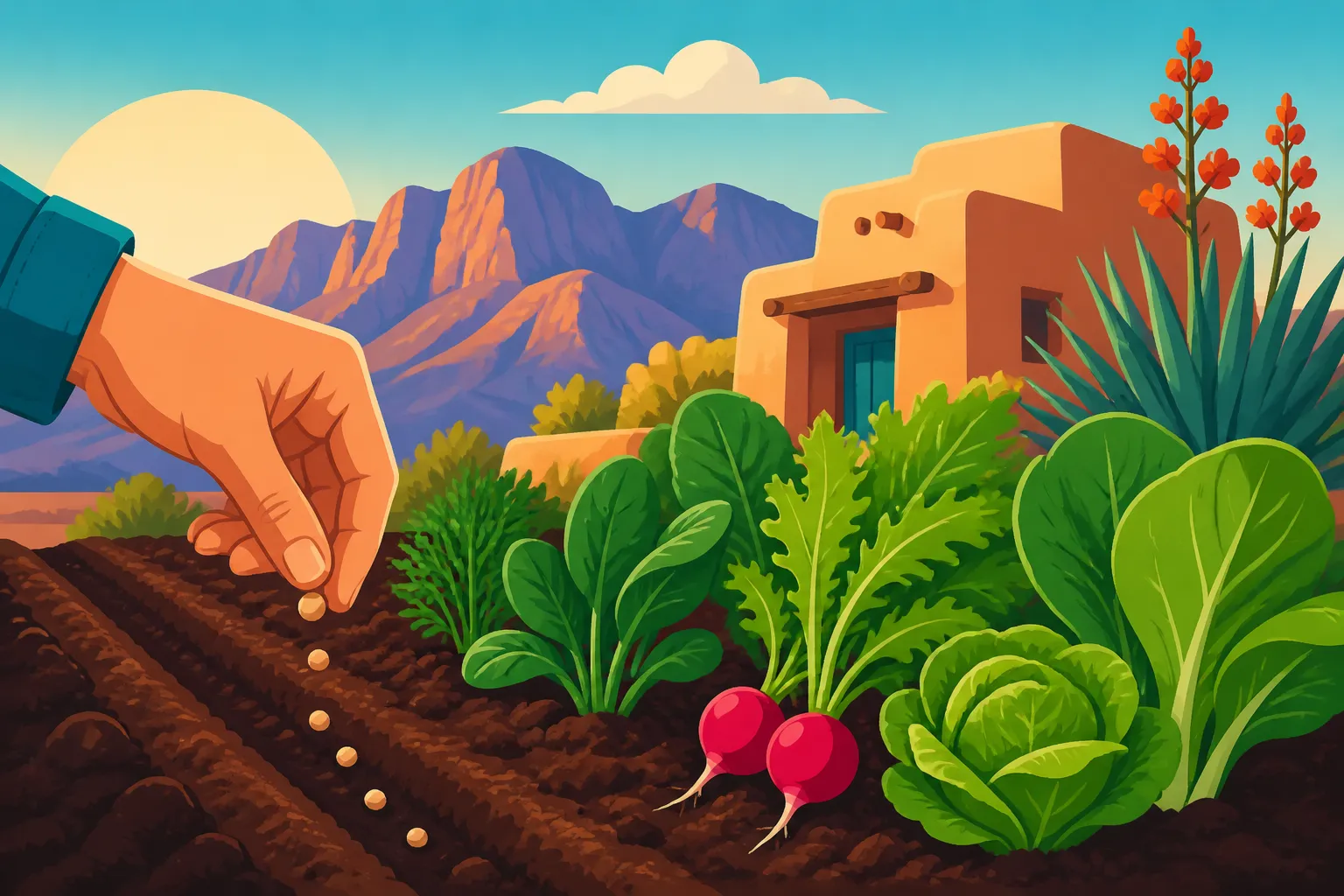
Radishes are one option when you want a relatively quick crop. According to New Mexico State University, radishes mature 3-6 weeks after seeding and can be grown as a spring or fall crop. Their short time to maturity can make them useful for a small early sowing, succession planting, or a trial in a bed where you are still learning how the soil performs. For practical considerations specific to them, see Sowing Radishes and Carrots in Early New Mexico Spring.
Carrots can be direct-seeded, but their small seeds and slow early development make a well-prepared bed especially helpful. Aim for a fine, even seedbed without large clods or crusting over the seed row. Keep track of where you sow, since a bare row can be hard to distinguish from weeds before seedlings emerge. The article Cool-Season Crops to Direct-Sow Before the Last New Mexico Frost focuses on timing; for sowing choices more broadly, Direct Seeding vs. Transplanting Vegetables in New Mexico explains how the two methods differ.
Peas, spinach, and lettuce are common cool-season possibilities for an early sowing, while other crops may be better started later or transplanted. Their suitability can depend on the variety, local conditions, and what the seed packet recommends. In a high-elevation garden with a short season, early sowing may be useful, but cold nights and slow soil warming still matter. For peas, see Planting Hardy Peas in Early Spring Without Waiting for Mother’s Day. For additional regional considerations in exposed or elevated gardens, consult Early Spring Sowing Windows for New Mexico High Deserts.
Not every crop labeled “cool-season” is equally suited to the same bed or week. If you have limited space, prioritize the crops you actually want to eat and those whose directions fit the conditions you can provide. A crop that needs a consistent seedbed or more protection may be a poor match for a windy, exposed plot, even if it is generally associated with cool weather.
| Crop or crop group | Why it may suit an early sowing | What to check before planting |
|---|---|---|
| Radishes | They can be grown as a spring or fall crop and mature relatively quickly | Seed-packet guidance, bed moisture, and the near-term forecast |
| Carrots | They can be direct-seeded into garden soil | Fine seedbed texture, row marking, and even moisture |
| Peas | They are a familiar cool-season option for direct sowing | Variety directions, soil condition, and exposure to cold wind |
| Spinach and lettuce | They may be suitable for cool-weather sowing | Packet instructions, local warmth, and whether protection is available |
Use the table as a starting point rather than a planting prescription. A crop’s response can vary with its variety and with local conditions. If a packet recommends sowing at a different stage of spring than your regional calendar suggests, weigh that instruction against the forecast and your garden’s microclimate. A calendar provides context; the packet and the site help make the final choice.
Be selective about what you sow
An early planting does not need to fill the whole garden. A short row of radishes, a small patch of carrots, or a modest sowing of peas can help you learn how a bed behaves without making a large commitment. You can expand the planting when the weather and soil are more dependable.
It is also fine to split a crop between early and later sowings. That approach can help avoid having an entire crop exposed to the same cold spell, and it may spread the harvest rather than concentrating it. Keep each sowing labeled with the crop and date so you can compare emergence and growth. If the early attempt is slow or uneven, that information is useful for deciding whether to wait, add protection, or try a different location.
Prepare the bed and choose a sowing day
A seed needs more than a calendar opening. It needs suitable contact with soil, moisture, and a place where it can grow without being buried under clods or washed away. Spend time preparing the bed before opening seed packets.
Remove weeds and leftover plant material that could make it hard to see seedlings or create competition. Break up compacted areas and smooth the surface enough to create a consistent seedbed. Avoid working soil when it is so wet that it smears or packs into clods. If the bed is too wet to crumble, waiting for it to dry can be more useful than sowing immediately.
For carrot and radish rows, a relatively fine surface helps small seeds make contact with the soil. Larger seeds, such as peas, are easier to handle, but they still need to be planted according to their packet directions. Do not assume all seeds should be planted at the same depth or spacing. Follow the label, because crop and variety instructions differ.
Check the bed for drainage. A low spot that remains wet after rain or irrigation may not be a good place for seeds, particularly when cool weather slows drying. If water pools, consider another part of the garden or adjust the bed so excess water can move away. At the other extreme, a sandy, exposed bed may dry rapidly and need closer moisture checks. For a broader look at matching crops to local soil, see Matching Garden Crops to New Mexico Soil and Region.
Use the forecast as one part of the decision
A forecast can help you decide whether to sow now, but do not treat a brief period of mild weather as proof that frost risk has passed. Check forecasts for the area around your garden and notice whether temperatures are expected to drop, whether wind is likely, and whether rain may leave the soil saturated. Conditions vary across New Mexico, so a forecast for a nearby town may not describe a high ridge, a sheltered courtyard, or a low garden pocket exactly.
If the bed is exposed and a cold spell is approaching, you can delay sowing or prepare a way to protect the row. A cover can moderate conditions, but it should be set up so it does not press down on seedlings or trap excessive warmth on a sunny day. The right approach depends on the cover material and the expected weather, so follow its instructions and keep an eye on conditions beneath it. For more on these decisions, see High-Desert Planting Windows and Freeze Protection.
Soil temperature can be another useful consideration, especially when a crop’s packet gives a preferred range or describes when to sow. Avoid guessing at a precise soil temperature from the feel of the air. If you use a soil thermometer, take readings where the seeds will be planted and follow the thermometer’s instructions. Where no measurement is available, treat cool, persistently wet soil as a reason to be cautious rather than assuming that a warm afternoon has warmed the whole bed.
Make the seed row easy to manage
Mark rows before sowing, and keep labels where you can see them. This is especially helpful when seeds are slow to emerge or when several crops are planted close together. A visible label can prevent accidental hoeing or watering mistakes and help you remember which packet directions apply to each row.
Sow evenly, then cover seeds as directed on the packet. Water gently so the seedbed is moistened without washing seeds into a low spot or exposing them. The goal is consistent moisture, not a waterlogged surface. Check the bed regularly while waiting for emergence, because wind and dry air can draw moisture from the surface even when the deeper soil still feels damp.
If you are planting several crops, group them by their needs rather than by convenience alone. Crops that need frequent attention can go somewhere easy to inspect. A row that is difficult to reach may be a poor location for tiny seeds that need careful monitoring. Good placement saves effort and makes it easier to respond if the weather changes.
Care for seedlings and respond to cold
After sowing, the job shifts from choosing a date to checking how the bed is behaving. Keep the seed row evenly moist in accordance with the crop’s needs, and look for crusting, erosion, or drying. A crusted surface can make emergence more difficult for small seedlings. Gentle watering and a well-prepared bed can help reduce the chance of disturbing the row, though no method removes every risk.
Once seedlings emerge, identify them before thinning or removing nearby plants. Young crop seedlings can resemble weeds, especially when they first appear. A row marker, a sketch of the bed, or a note about where each crop was sown can help. Thin crops only as the packet directs, since crowded seedlings compete for light, water, and space.
Keep an eye on overnight conditions during the period when frost is still possible. If a cold night is forecast, use an appropriate protective cover or move a container-grown crop to a more sheltered place if practical. Covers are not a guarantee: they need to be secured against wind and used according to their instructions. Remove or adjust them when conditions become too warm, and avoid letting wet fabric rest on tender plants.
New Mexico’s dry air and wind can create another problem: a seedbed may dry between checks even when the season feels cool. Water according to actual soil moisture rather than a fixed schedule. Check beneath the surface near the row, because the top layer can appear dry while the soil below remains moist, or look damp after a light sprinkle while the seed zone has dried. For a deeper discussion of irrigation decisions, see New Mexico Garden Watering Schedules: Frequency and Run Times.
When the forecast turns colder
If seedlings are already up and a frost is expected, protect them when you can, but avoid assuming every crop will respond alike. A young plant may be more vulnerable than a mature one, and a clear, calm night can produce different conditions from a windy night. If the plants are not yet up, a short delay in sowing may be an easier choice than trying to manage an exposed seed row through a cold spell.
If seeds have not emerged when expected, first consider whether the bed dried out, became waterlogged, or crusted over. Cold soil can also slow germination. Check the seed packet for its expected conditions before concluding that the seed has failed. If the row is still empty after conditions improve, a small re-sowing may be more practical than disturbing the entire bed.
Do not overcorrect by watering heavily or digging up every seed to inspect it. Those actions can damage seeds that are still viable or make the seedbed less stable. Instead, observe the row, check moisture carefully, and give the crop conditions consistent with its directions. If the first sowing does not establish, note what happened and adjust the next attempt.
Keep records that improve the next decision
A useful garden record does not need to be complicated. Write down the crop, the location, the sowing date, the weather around sowing, and when seedlings appeared. Note whether a cover was used and whether the soil seemed wet, dry, or workable. Those details can help distinguish a timing issue from a bed-preparation or moisture problem.
Keep records specific to each part of the yard. A sheltered wall and an exposed corner can behave differently, even if both are in the same garden. Repeating a small trial in more than one location can show which spot warms sooner and which one needs protection. Over time, those observations become more useful than trying to apply one planting date to every bed.
Frequently Asked Questions
Can I sow cool-season crops before the last frost?
Yes, some cool-season crops can be sown before the final spring frost when the crop, soil, and forecast are suitable. Check packet directions and consider your garden’s exposure rather than treating the last frost as a fixed date.
Which crops are suitable for direct sowing?
Carrots and beans are examples New Mexico State University identifies for sowing directly into garden soil when conditions are favorable. Radishes are another option for a spring or fall crop. Check each crop’s packet for specific sowing guidance.
Should I wait if the soil is wet?
If soil is too wet to work without smearing or forming clods, waiting can help preserve a better seedbed. Sow once the soil is workable and the bed can be prepared without packing it down.
What should I do if frost is forecast after sowing?
If seeds are not yet up, delaying the sowing may be simplest. If seedlings have emerged, consider a suitable cover and follow its use instructions. Check conditions under the cover and remove or adjust it when needed.
Sources
- New Mexico State University — Growing Zones and Planting Information for Home Vegetable Gardens in New Mexico | New Mexico State University – BE BOLD. Shape the Future. (checked November 15, 2026)
Disclaimer
This article is for general informational purposes only and does not constitute professional advice. Laws, prices and regulations vary by location and change over time. Consult a qualified professional for guidance on your specific situation. New Mexico Gardening Guide is not a government agency and is not affiliated with any university extension, state department of agriculture or other government agency.